
Parole can be one of the most confusing parts of the Texas criminal justice system, particularly for incarcerated individuals and their families trying to determine when someone may be released.
Becoming eligible for parole does not mean an individual will automatically be released. Parole is a discretionary decision made through the Texas Board of Pardons and Paroles, and many factors can affect the outcome.
Understanding the difference between eligibility and approval is an important first step.
What Is Parole in Texas?
Parole allows an eligible incarcerated individual to serve the remainder of a sentence in the community under supervision after receiving approval from a parole panel.
The Texas Board of Pardons and Paroles describes parole as a privilege rather than a right. Reaching the parole eligibility date therefore does not guarantee release.
What Is the Difference Between Parole and Probation?
Although parole and probation both involve supervision in the community, they occur at different stages of the criminal justice process.
Probation, generally referred to as community supervision in Texas, is typically ordered by a court instead of requiring the individual to serve the entire sentence in jail or prison.
Parole, occurs after an individual has been incarcerated and becomes legally eligible to serve the remaining portion of the sentence under supervision in the community.
The two should not be treated as interchangeable terms.
Who Is Eligible for Parole in Texas?
Parole eligibility depends on several factors, including the offense, sentence, offense date, and applicable Texas law.
The TDCJ Correctional Institutions Division Records Office calculates parole eligibility dates. The amount of a sentence that must be served before reaching eligibility varies according to the nature of the offense and the statute that applies, and good conduct time can affect the calculation in some cases.
Because of these differences, there is no single parole formula that applies to every Texas inmate.
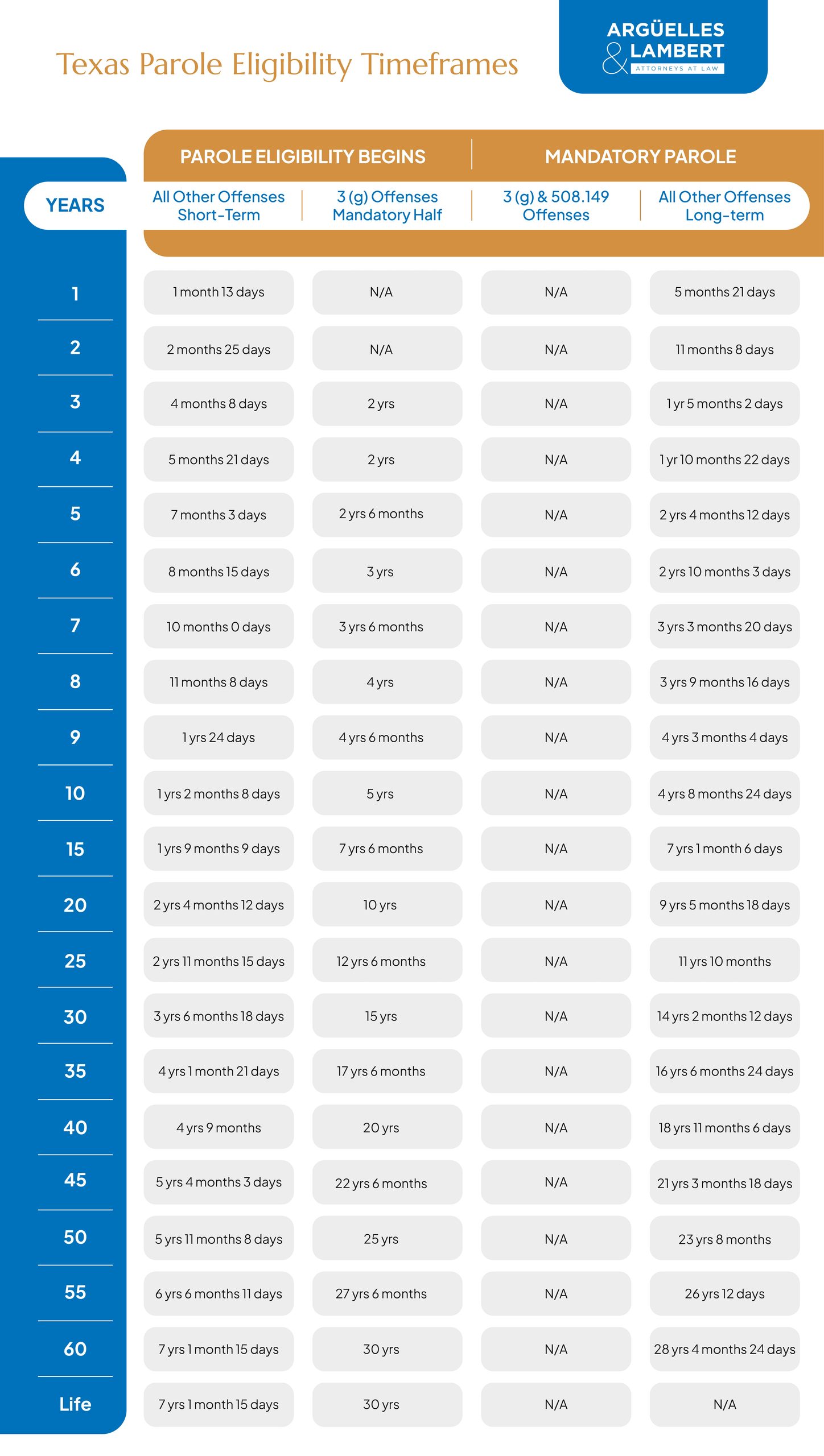
TDCJ Parole Eligibility Chart: Texas Parole Requirements
The following chart provides an overview of parole eligibility requirements in Texas. Eligibility depends on several factors, including the offense, sentence, and applicable Texas law.
What Does “3G Offense” Mean in Texas?
Families researching parole frequently encounter the term “3G offense.”
This is older terminology derived from former Article 42.12, Section 3g of the Texas Code of Criminal Procedure. TDCJ’s current materials refer to offenses formerly known as 3g offenses, so the term remains common even though the statutory framework has changed.
These offenses historically included certain serious crimes and can be subject to different parole eligibility requirements.
Because parole rules have changed over time, the date of the offense and applicable law are important when calculating eligibility.
What Does “Mandatory Half” Mean?
The phrase “mandatory half” is commonly used when discussing certain serious Texas offenses for which an incarcerated person may be required to serve a significant portion of the sentence in actual calendar time before becoming eligible for parole.
However, parole eligibility rules vary based on the offense and when it was committed. For that reason, simply applying a “half the sentence” calculation to every serious felony can produce an incorrect eligibility date.
TDCJ maintains specific eligibility requirements based on the applicable legislative period and offense classification.
Does an Inmate’s Custody Level Affect Parole?
Custody classification and parole eligibility are separate issues, but an inmate’s behavior while incarcerated can matter during parole review.
The Texas Board’s current parole guidelines use both static and dynamic factors to assess risk. Dynamic factors include education and vocational programs completed during incarceration, disciplinary conduct, security-threat-group membership, and the individual’s current prison custody level.
This means institutional behavior and adjustment can become important parts of the overall parole evaluation.
How Does the Texas Parole Review Process Work?
The parole review process generally begins before the actual eligibility date.
TDCJ identifies offenders approximately six months before their initial parole eligibility and approximately four months before subsequent review dates. An Institutional Parole Officer interviews the offender and prepares a parole case summary.
The case then goes to a parole panel consisting of three voting members. Two votes are required for a final decision.
If parole is denied, the individual is notified of the decision and given a future review date. If approved, the release may include special conditions.
What Does the Texas Parole Board Consider?
There is no single factor that determines whether parole will be granted.
According to the Texas Board of Pardons and Paroles, factors considered can include:
- Seriousness of the offense
- Criminal history
- Length of the sentence and time already served
- Previous periods of probation or parole
- Institutional behavior and adjustment
- Participation in programs
- Age
- Letters supporting or protesting release
The Board also uses parole guidelines that combine an assessment of risk with the severity of the offense. However, the resulting guideline score does not automatically determine whether parole will be approved or denied; parole panel members retain discretion.
What Is Mandatory Supervision?
Under Texas law, certain eligible incarcerated individuals may qualify for release when their actual calendar time served plus applicable good conduct time equals their sentence. However, not every offender is eligible, and for certain cases the Board may deny release after review.
This is why the term “mandatory parole” can be misleading. Parole is discretionary, while mandatory supervision is a separate form of supervised release governed by its own eligibility requirements.
Does Parole Eligibility Guarantee Release?
No.
This is one of the most important things for incarcerated individuals and their families to understand.
A parole eligibility date establishes when someone can be considered for parole. It does not establish when that person will actually leave prison.
The final decision depends on the parole review process and the individual circumstances evaluated by the parole panel.
Preparing for Parole Review in Texas
Because the Board considers far more than the eligibility date itself, preparing for parole review can involve presenting information about rehabilitation, institutional conduct, support systems, and plans for successfully returning to the community.
Every case is different, and the offense, sentence, criminal history, institutional record, and applicable Texas law can significantly affect the process.
Questions About Parole in Texas?
Understanding parole eligibility and preparing for parole review can be complicated, particularly when serious felony offenses or older convictions are involved.
Arguelles & Lambert helps clients and families understand the Texas criminal justice process and the legal issues that may affect their cases.
Contact our San Antonio Law Firm Office if you have questions regarding a Texas criminal case or parole-related matter.
Disclaimer: This article is for informational purposes only and does not constitute legal advice. Reading this content does not create an attorney-client relationship.